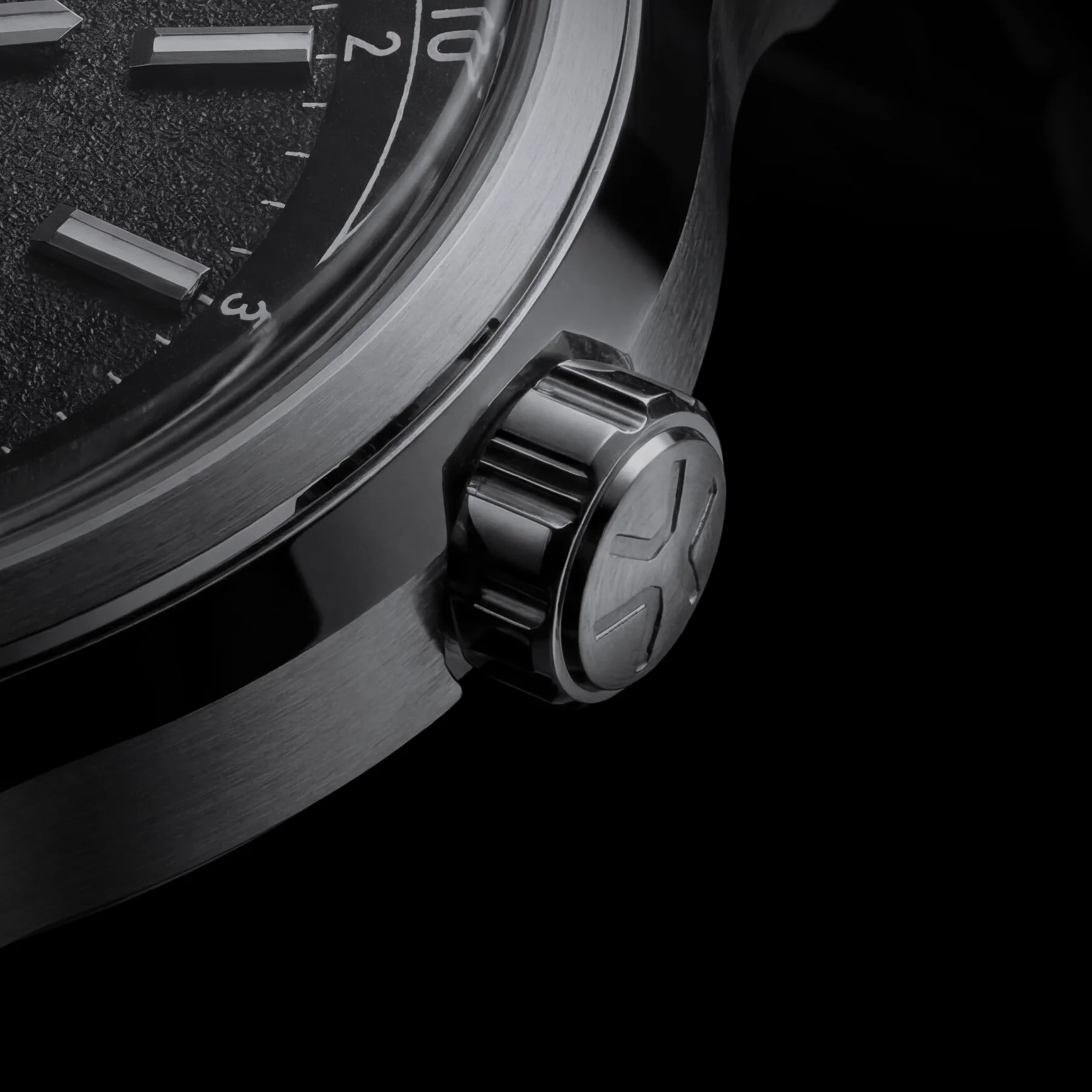
Unicrown: One Crown, Four Functions
How the Unicrown came about, from an aeronautical engineer’s blueprints to a single-crown mechanism.
The best mechanical ideas rarely announce themselves. We look for them in old watches and daily habits, then refine what still holds up. That approach led to our first watch, the UC1 Recurve.
Where it started
My appreciation for design started young, immersed in the engineering drawings of my father, an aeronautical engineer. Those drawings solved real problems with precision, and they still shape how I work.
A table I designed to fix my own laptop-at-home problem ended up with Herman Miller. At IDEO I worked on Zuowe, a home-office brand started during COVID. Both taught me the same lesson: watch how people actually use a thing, then design for that.
My fascination stayed with watches, particularly the quiet innovations of mid-century watchmakers. One Japanese maker introduced an internal rotating bezel through a single crown: intuitive, but hindered by a friction mechanism that could slip during wear. A Swiss maker geared the bezel to the stem. Its patent also described a version that disengaged the bezel when the crown was pulled out.
Working in China
I’ve worked with all types of Chinese manufacturers for over a decade and watched the quality climb year on year. UC1 Recurve is built with a series of specialist partners from southern China.
Fixing the internal bezel
The internal rotating bezel was innovative but flawed. Even modern world-timers still use friction bezels, lacking tactile precision and often leading to thicker cases. Two-crown compressor revivals separate the functions cleanly, but at the cost of simplicity.
We saw the opening: a single-crown internal bezel with real clicks, in a slim case. The Unicrown system (patent pending) is the result.
A single-crown internal bezel, in distinct clicks, in a 10.5 mm case.
Getting the click right
Each bezel click was prototyped over and over: chamfer angles revised through AR checks and metal 3D prints until the resistance felt even in the fingers. The precision is something you feel rather than read about.
Where this goes next
UC1 Recurve is in final prototyping. The list hears everything first — progress, pricing, and the setbacks too.
— Sam McMorran, Founder